Simferopol Local History Museum,
Alushta Museum of Nature,
Kherson Local History Museum,
Museum of the History of Simferopol Gymnasium No. 1.
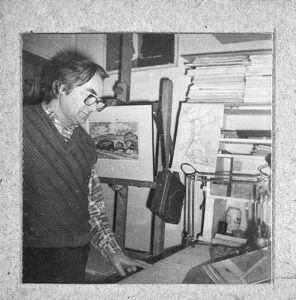
In his works, Chystylin sought to draw attention to historical landmarks of Crimea and preserve their image.
His most well-known works include:
Winter Ai-Petri (1981) — one of his most famous watercolors, depicting a snow-covered mountain peak shrouded in mist.
A series of illustrations for the 200th anniversary of Simferopol — created for a jubilee album that, unfortunately, was never published during the artist’s lifetime. This series continues to be regularly used by Crimean museums and galleries, particularly in city design projects, almanacs, and similar publications.
In the 1970s–1980s, the artist’s home became a hub for creative people of Crimea. Artists, art historians, and jewelers would gather there. Among his close friends and sources of inspiration were:
Mykola Lyadovsky (graphic artist),
Oleg Hrachov (painter),
Anatoliy Kozlov (watercolor master who had a significant influence on Chystylin).
Today, Pavlo Chystylin’s works are preserved in:
Simferopol Art Museum (Crimean Art section),
Bakhchisarai Historical, Cultural, and Archaeological Museum-Reserve,
Private collections in Ukraine, Russia, and abroad.
The majority of the artist’s works have been held privately by his heirs for over 35 years.
Chystylin’s art remains a testament to dedication to his craft, love for his native land, and continuous exploration in painting techniques. His intimate watercolors not only captured the disappearing image of Crimea but also became a source of inspiration for new generations of artists.
Chystylin’s work is highly valued by art historians and critics. His works have repeatedly been discussed in exhibitions and publications.
His pieces were featured in the exhibition Artists of Crimea at the Simferopol Art Museum, where he is described as “an original Crimean artist working at the intersection of painting and graphics.”
In 2013, an exhibition in Simferopol was dedicated to his graphic works. Lyudmyla Borodina, Executive Secretary of the Crimean Branch of the National Union of Artists of Ukraine and an art historian, noted:
“Pavlo Leonidovych was a lyrical artist, extraordinarily subtle and perceptive in his works. His painting style is restrained and very modest, which is his hallmark.”
Honored Crimean art historian Elmira Cherkezova emphasized:
“The entire body of the master’s work is filled with love for the nature of Crimea, the uniqueness of which he felt and understood with great subtlety.”
In December 2023, the Tavrida Museum published an illustrated almanac, featuring works by Pavlo Chystylin, demonstrating the enduring interest in his art.
A Simferopol Art Museum publication describes Chystylin as “an original Crimean artist working at the boundary of painting and graphics.”
In an article devoted to his watercolor Winter Ai-Petri, it is noted:
“The composition and subject of the watercolor are exquisite, reminiscent of a Japanese miniature… thanks to the richness of shades and impeccable technique, there is a sense of the boundless space of the Crimean mountains.”
These reviews highlight the uniqueness and depth of Pavlo Chystylin’s work, his ability to convey subtle lyrical images, and his profound connection to the nature and architecture of Crimea.
Despite the limited availability of references due to the political conflict surrounding Crimea, Chystylin’s participation in significant contemporary cultural projects and the presence of his works in museum collections confirm his important role in the development of Crimean art.
Pavlo Chystylin was not merely an artist but a true chronicler of Crimea. His watercolors are not merely images but living memories of time, history, and nature. Chystylin’s work continues to inspire, proving that art is not only technique but also a way of seeing and conveying the beauty of the world.
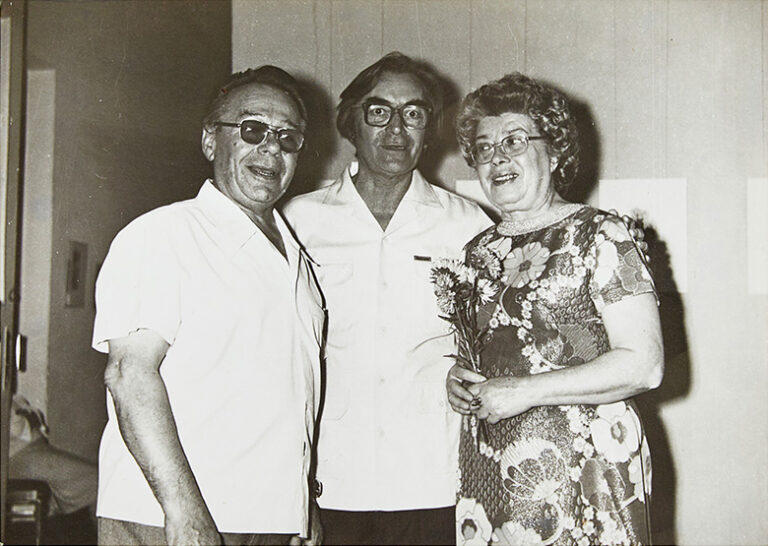
Lyadovsky M.M., Chystylin P.L., Chystylina R.V. (wife)